Backgammon: Prime or Blitz is on the App Store — free, with no ads, no coins, and no account. Sit down, roll, play. It’s the game I’ve played the longest, and it’s the one I built first.
Every one of my games this year has been free with a tip jar behind a heart. That rule, and most of the others, got decided here. Backgammon is the pilot for the family.
How it plays
Play a single game, or a match to 3, 5, or 7 points. Face the computer at three levels — Dunce, Normal, or Einstein — or hand the iPad across the table and play a friend. Tap a checker, tap where it goes. The board only lets you make legal moves, and Undo is there if your thumb picked the wrong one.
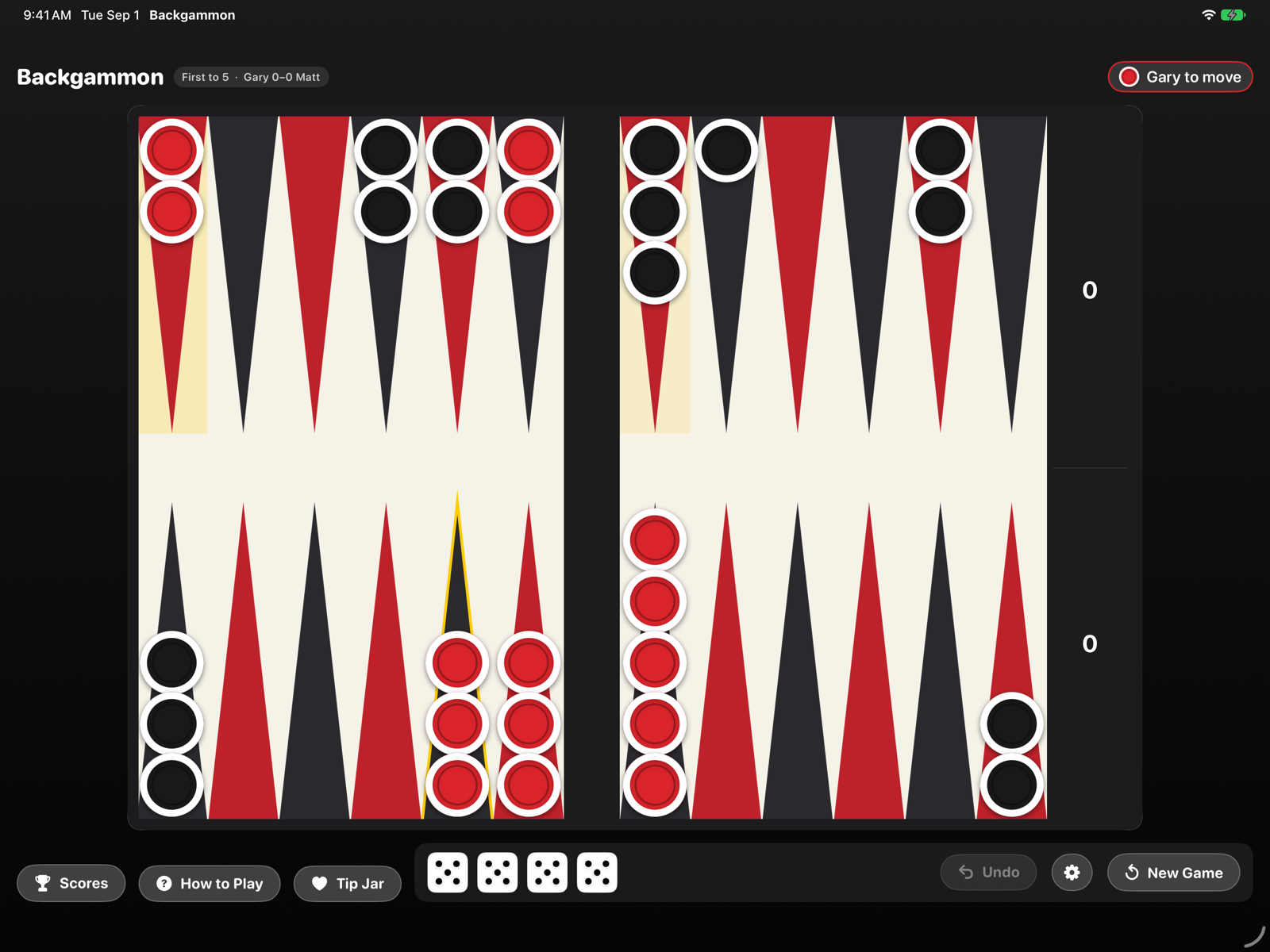
The name is the two ways you win a backgammon game. A prime is a wall: four, five, or six points in a row that your opponent’s back checkers can’t get past. A blitz is the opposite mood: hit every loose checker you can, close your home board, and don’t let them back in. Most real games are a running argument between the two, and the dice have opinions.
The computer knows both. When it weighs a move it counts the race, values every made point and anchor, checks how many of the 36 rolls would hit a loose checker and how much that would cost, and gives a growing bonus to a prime in front of your rearmost checker. Einstein plays that evaluation straight. Normal adds a little noise to it, so it has good days and bad ones. Dunce picks any legal move it likes, which is a fine way to learn the game without losing every time.
The cube
In match play the doubling cube is waiting. When you like your position, offer it. Your opponent takes and the game is worth double, or drops and you win the point outright. The computer offers when its pip lead is real, roughly ten percent, and it takes and drops on the same arithmetic.
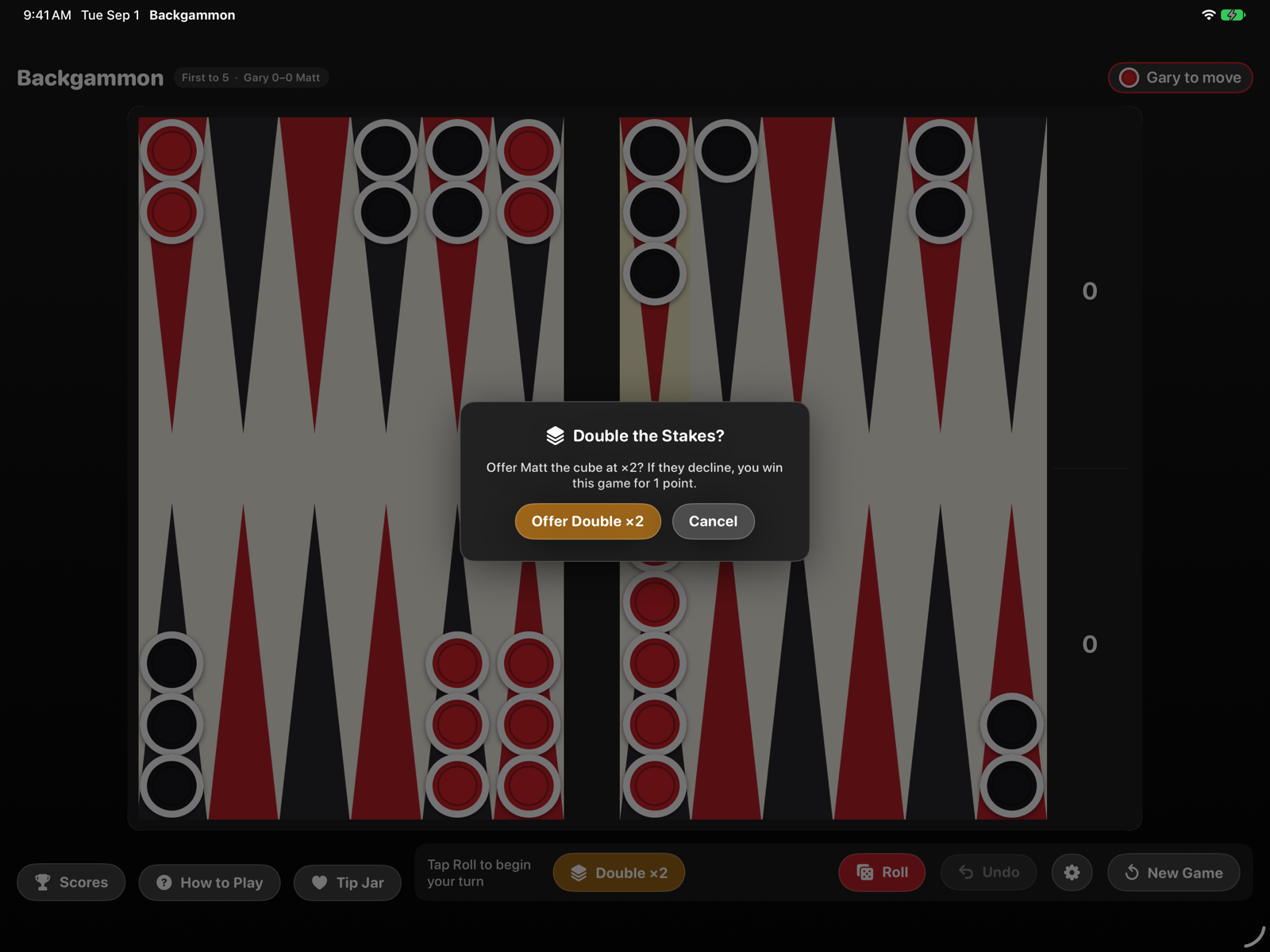
Gammons count double and backgammons triple, multiplied by the cube. A doubled backgammon is six points, and in a match to 5 that’s the whole match in one game. It doesn’t happen often. That’s why the biggest tip in the jar is named for it.
The leaderboard remembers
Out of the box you play the Computer. Tap the name and call it anything you like — mine is Matt. Add your own name too, and every result goes on the record under the names it was played with: gammons and backgammons badged, match wins on their own board, and your best games ranked on top. Tap any entry and it shows you the final board position.
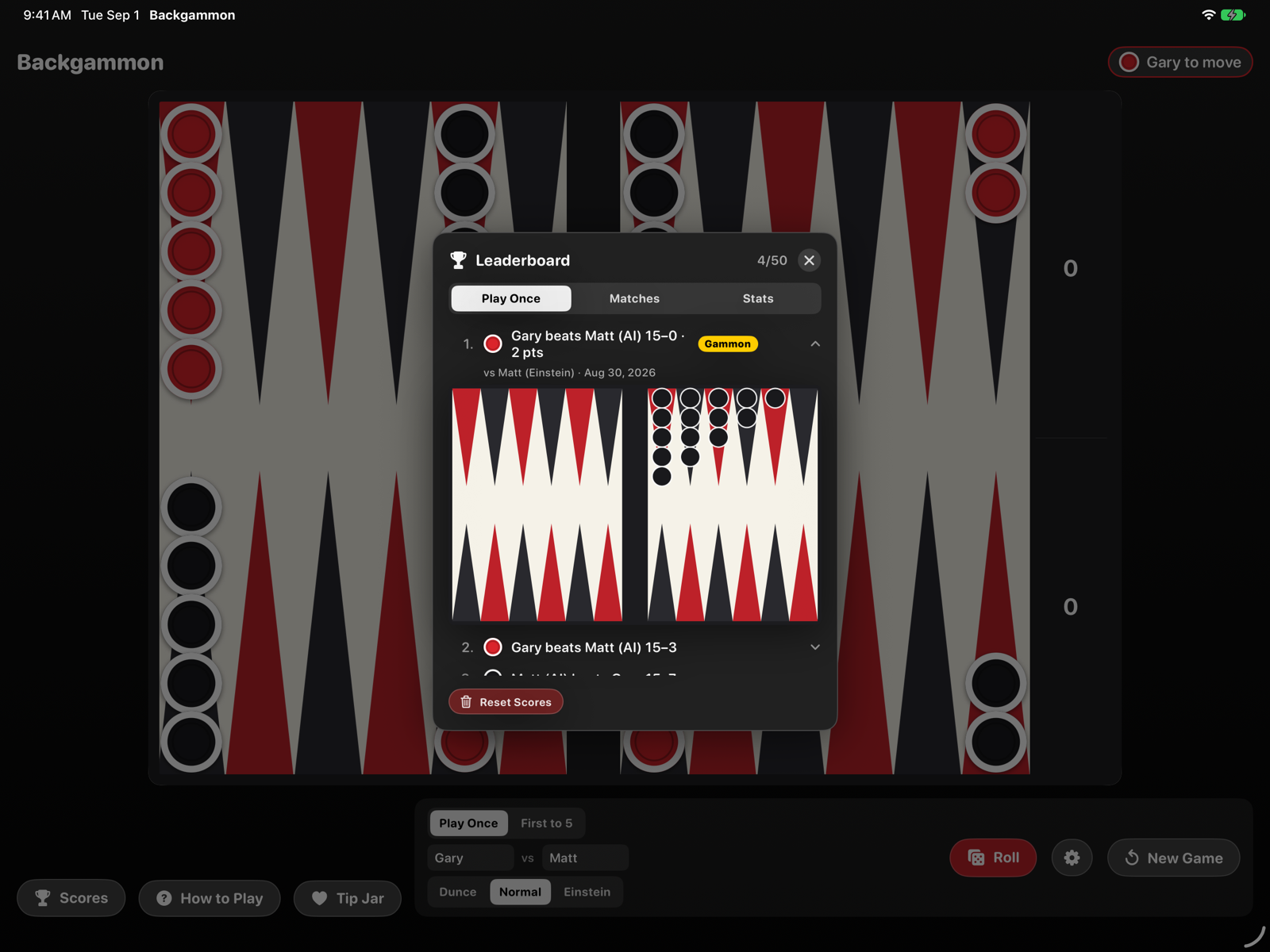
Renaming an opponent starts a new era. History is never rewritten. Scores live on your iPad, and nothing leaves the device.
Why the pilot
I wrote in an earlier post about the app bible, the playbook the whole family inherits. Backgammon is where that playbook was written, one decision at a time, by playing the game and noticing what bothered me.
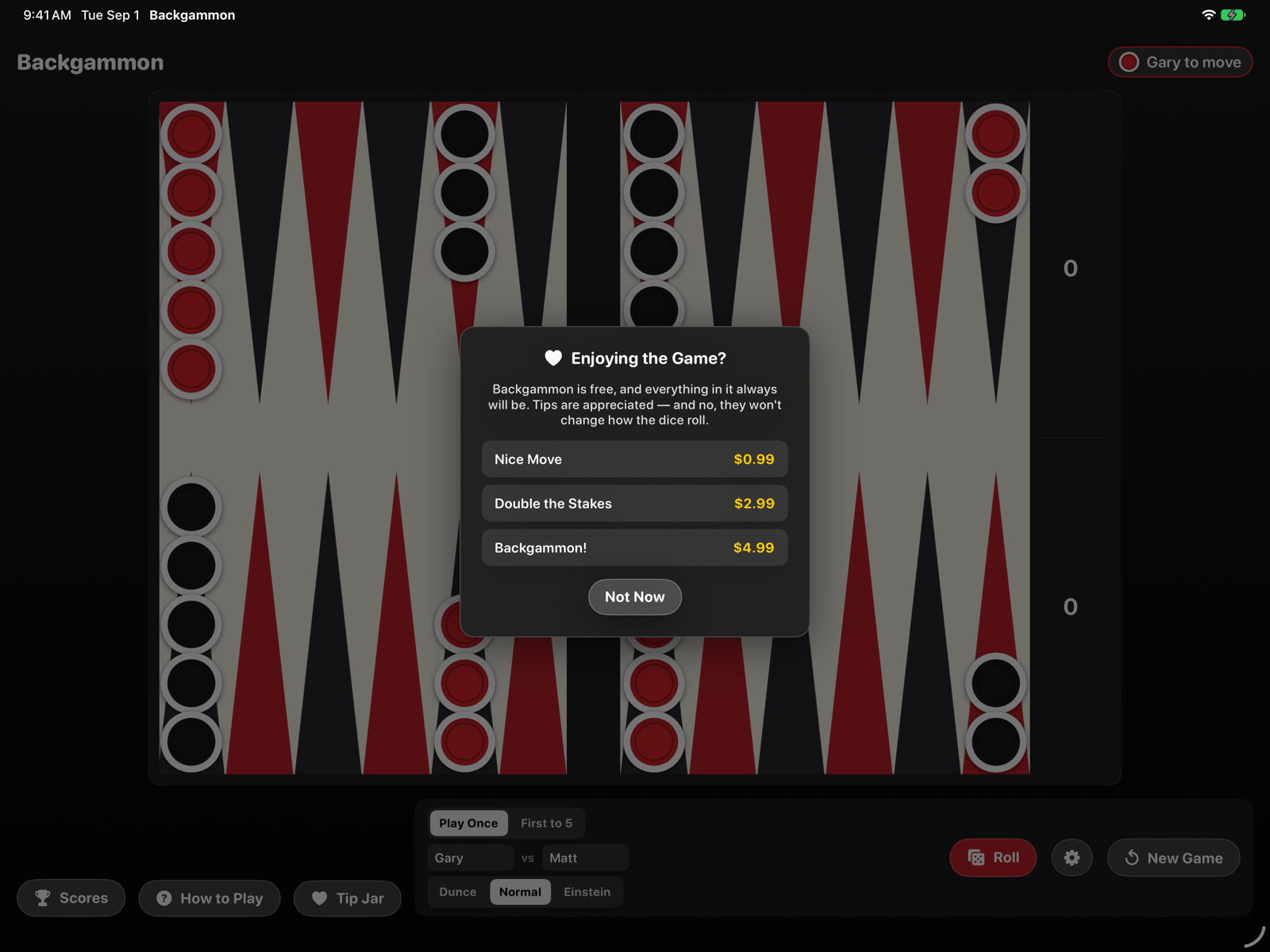
- The tip jar gets its own button. I never use gear menus, so nothing that matters hides in one. The heart sits in the main row next to Scores and How to Play. Every game after this one has it in plain sight.
- The tiers climb the game’s own ladder. Nice Move, Double the Stakes, Backgammon! The other games named theirs the same way: Cribbage’s biggest tip is Twenty-Nine!, and Gin Rummy’s is Big Gin.
- A leaderboard never forgets a best game. When the list fills, the lowest result drops, not the oldest. Your 15–0 gammon from last spring stays.
- The opponent ships as “Computer.” An early build had Matt as the default. I installed it on a fresh iPad mini, saw a stranger’s name staring back, and understood that Matt only means something to me. Names are created by the player, never by the app.
- Dark theme, centered overlays, no system popovers. The cube offer, the tip jar, the leaderboard all use the app’s own card so the whole thing feels like one object.
- iPad only. I tried it on the phone. The board doesn’t fit in either direction, and I don’t enjoy a game on a phone that’s better on a bigger screen. The card games followed; the two quick dice games went the other way, phone only, and that was decided the same way, by playing them.
Being the pilot also meant taking the longest road through App Review. Backgammon went in on September 1 and was approved on September 24, after three weeks of back and forth about whether five games from one person were one game five times. They aren’t, and the evidence was in the apps themselves. Its siblings Cascade and EmberDice got through in days on the same rules Backgammon had already settled. That was the point of a pilot.
Sit down, roll, play
Backgammon: Prime or Blitz is free on the App Store, designed for iPad. If you enjoy it, there’s a tip jar behind the heart — no paywall, no ads, ever.
If you’d rather have something for the bus, the two commuter games are cut from the same cloth: Cascade: Dice & Card Duel and EmberDice: Bank or Burn.
Leave a Reply